
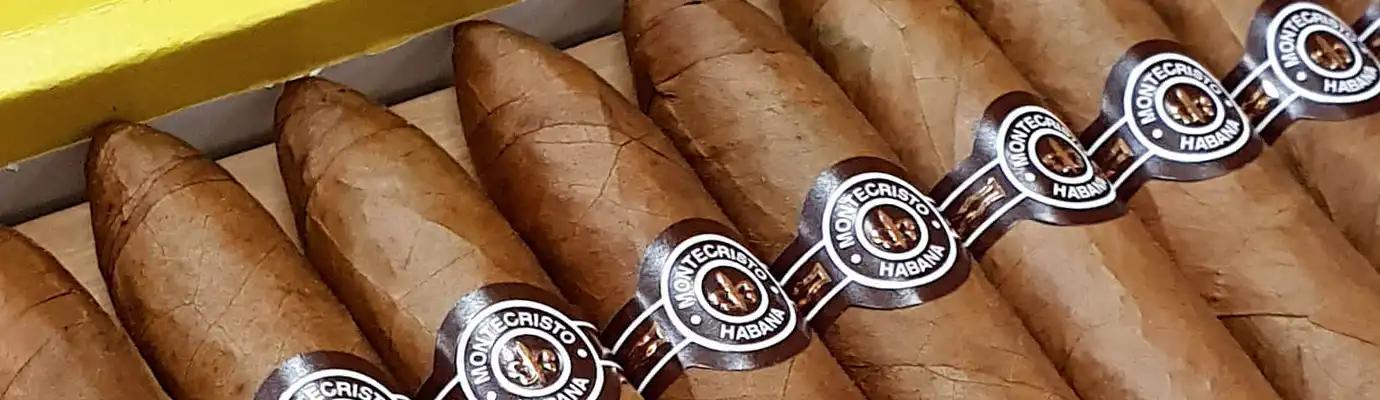
Authenticity of Cuban cigars - original cigars from Cuba
Habanos cigars are still among the most famous cigars in the world. It is therefore not surprising that they are often counterfeited. All of our Cuban cigars are checked for authenticity and we only purchase our cigars through official channels. To check this, the cigar boxes from Cuba have certain distinguishing features.




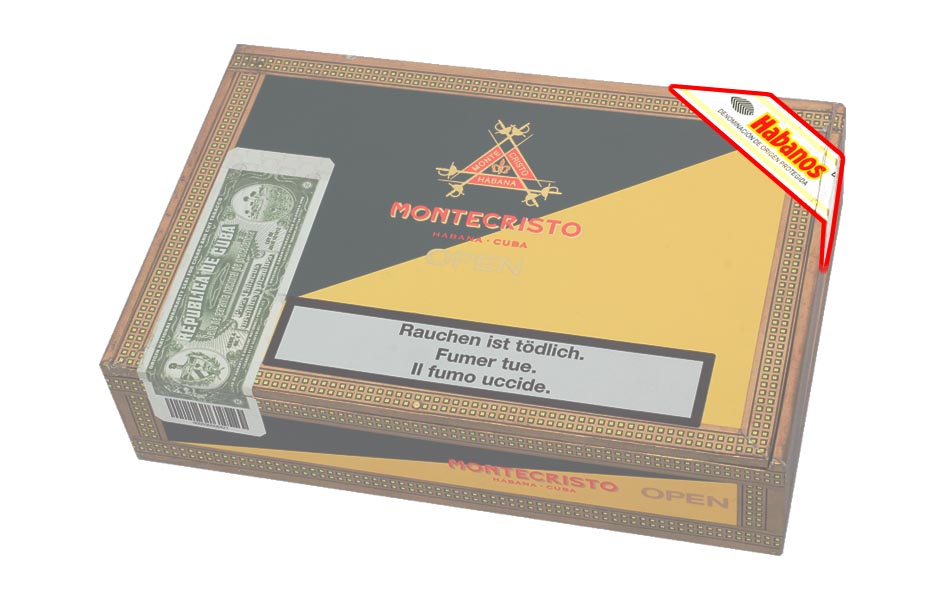
Guarantee seal of the Republic of Cuba
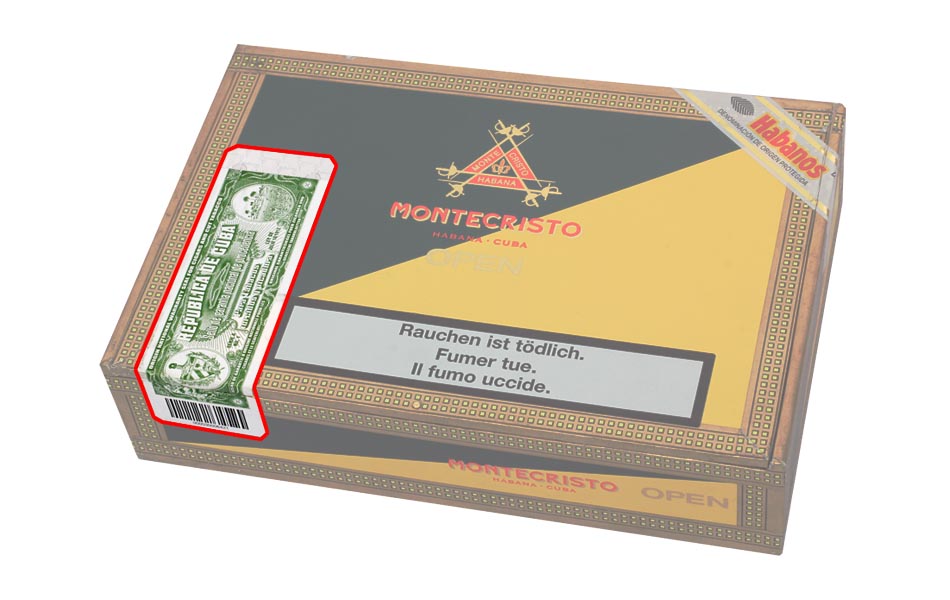
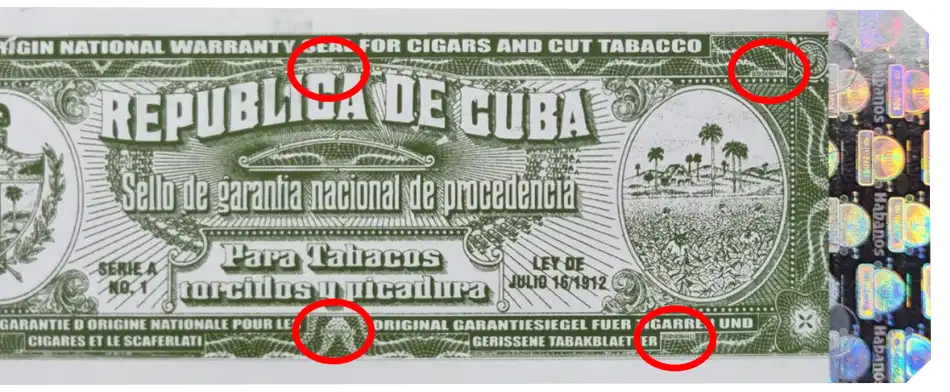
Since 1889, cigars from Cuba have been labelled with a guarantee seal by order of the King of Spain. The seal has been changed slightly a few times in the meantime, but is still an important part of the cigar boxes today. From 2009, the seal was supplemented with a hologram and an individual barcode. The barcode can be used to verify authenticity on the Habanos website www.habanos.com. In addition, an emblem becomes visible under ultraviolet light.
Habanos seal
Since 1994, all cigar boxes have carried the Habanos seal as a sign of a globally protected designation of origin.
By the way, if you receive a box of Cuban cigars from us and the guarantee and Habanos seals are broken, this does not mean anything bad. The importer and we open the boxes to check the quality of the cigars.
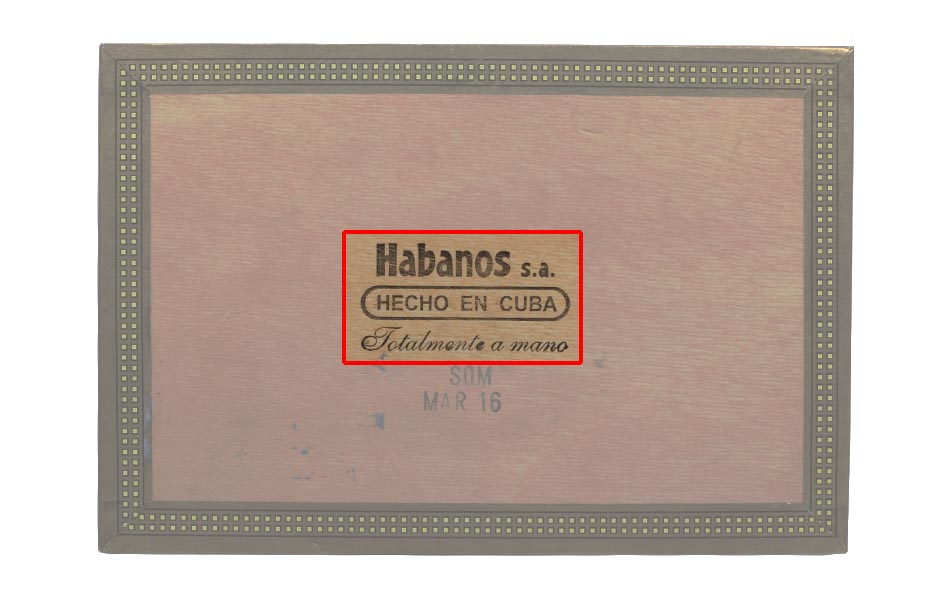
Branding on the bottom of the cigar box
Since 1960, all boxes have been branded on the underside. These differ depending on how the cigars were made:If only the Habanos S. A. logo and "Hecho en Cuba" are branded into the bottom, the cigars were made by machine. The boxes of these cigars also do not bear the Habanos D.O.P. seal. If the branding is extended with "totalmente a mano", these are long-filler cigars from Cuba made entirely by hand. These boxes bear the Habanos D.O.P. seal. If the branding is also extended with TC, this means that the cigars are short-filler cigars that have also been made entirely by hand.
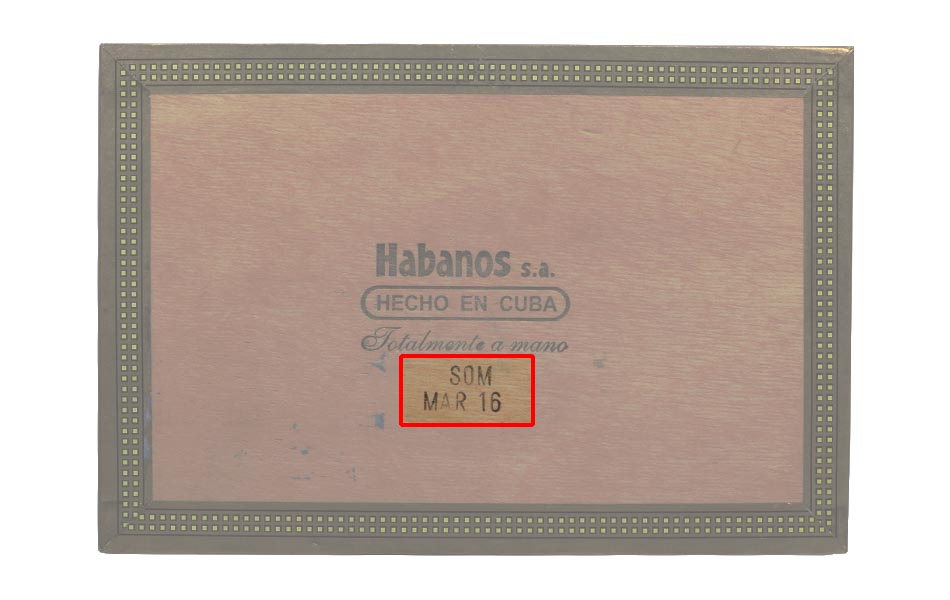
Stamp on the bottom of the cigar box
There are two stamps on the bottom of Habanos boxes: one is an encrypted code that indicates which factory made the cigars. The other is unencrypted and provides information about the year and month in which the Habanos were packed in the box. This is called the boxing date.The system was started in 2000 with "00", followed by "01".
- ENE (Enero) January
- FEB (Febrero) February
- MAR (Marzo) March
- ABR (Abril) April
- MAY (Mayo) May
- JUN (June) June
- JUL (Julio) July
- AGO (Agosto) August
- SEP (Septiembre) September
- OCT (Octubre) October
- NOV (Noviembre) November
- DIC (Diciembre) December
Check on our example
- The Habanos seal is present
- The guarantee seal is present, the number 00003006421 gives the following answer in the online check on the Habanos website: "The product is original from Habanos S.A. HSA: 10.8078.17.1860 Descripcion: MONTECRISTO MASTER CB-UW-C/L-10-n-20"
- Brand marks Habanos s.a. and Hecho en Cuba are present. The addition Totalemente a mano is also present, which means that these are handmade long-filler cigars.
- The cigars were made in the factory with the abbreviation "SOM".
- The cigars were packaged in March 2016.

Cuban cigarsare considered unique because many factors come together in Cuba: a traditional terroir with fertile soils, a humid climate and cultivation methods that have been refined over decades. The Vuelta Abajo region is particularly famous for producing tobacco leaves with characteristic depth and elegance. Added to this is the craftsmanship: from careful fermentation and maturing to rolling by experienced torcedores, every step is strictly controlled. The typical Cuban flavours range from earth, leather and wood to cocoa, coffee and fine spices. This interplay of origin, craftsmanship and style makes Habanos unmistakable for many aficionados.