

Humidors and humidifiers
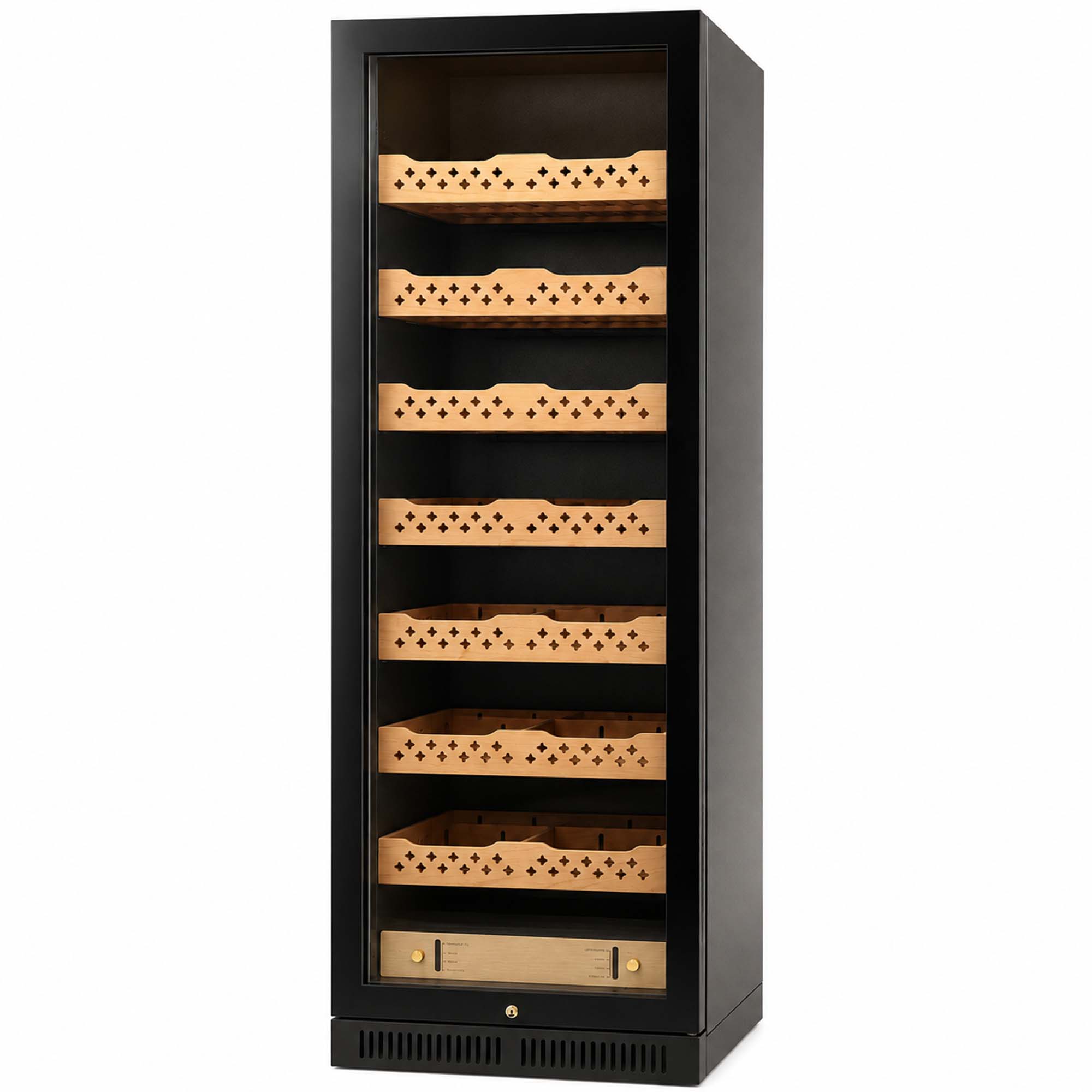
When it comes to the storage and care of cigars, the humidor plays a decisive role. Proper storage is the key to preserving the full flavour and quality of a cigar. And this is exactly where the humidor comes into play. The humidor is a specially developed container that provides optimum conditions for storing and maturing cigars. As a rule, the classic humidor is sufficient. However, if more cigars are to be stored, a humidor cabinet should be considered.
The correct humidification system is also crucial. Depending on the type of humidor, a two-way humidifier such as those offered by Boveda or Integra Boost is recommended, or classic passive humidification. If you want something more convenient, you can also use an electronic humidification system.
Top seller:




Humidor
Constant humidity, constant enjoyment
A good humidor transforms cigars into unforgettable moments
Why a humidor is indispensable
A humidor is not just a place to store cigars, but also a habitat for them. In its protected microclimate, wrapper leaves retain their elasticity, flavours remain connected and the draw remains reliable. Without a humidor, cigars dry out, burn too hot and taste flat; too much humidity makes them heavy, musty and susceptible to mould. The humidor keeps the centre - and therefore your collection - in top form. In short: if you want your experience to be predictable and repeatable, there's no getting round the humidor.
The optimum storage environment
Relative humidity (RH)
A range of 65-72 % RH has proven to be ideal. Many aficionados choose 68-70 % as the "sweet spot": sufficient humidity for creamy smoke and clean burning without straining the construction. Most blends develop most harmoniously in this window.
Temperature
The ideal temperature is 18-21 °C. Higher temperatures accelerate ageing and increase the risk of tobacco beetles; significantly lower temperatures dampen development and can "put the flavour to sleep".
Stability beats perfection
Consistency is more important than a precise target value. Fluctuations cause wrapper leaves to tear, change the draw and shift flavour profiles. A tight humidor with reliable humidification ensures smooth, small curves instead of a climatic rollercoaster.
Humidor types at a glance
Desktop humidor
The classic for 25-150 cigars. Compact, suitable for the living room, elegant. Perfect if you want to keep a curated selection to hand - and a beautiful object that celebrates the ritual as soon as you open it.
Travel and pocket humidor
Robust, sealed, with foam inlay: for weekends, holidays or club nights. So your flavour is safe with you - without compromising on moisture and protection.
Cabinet and cupboard humidor
Generous volume, stable climate control. For collectors and frequent smokers who want to store boxes or rest cigars. Often with electronic humidification and several sensor points.
Walk-in humidor
The premier class for shops and large private collections: precise technology, flexible organisation, perfect overview. Anyone who has ever stood in one understands why climate creates confidence.
Materials & construction
Spanish cedar wood (cedro)
Inside, cedro is a quasi-standard: it buffers moisture, supports maturation, exudes a subtle, pleasant woody note and is said to keep tobacco beetles away, although this is doubtful. It is the acoustic "sigh" when the lid closes and the fragrance that will make you smile before your first puff.
Exterior material & fittings
High-gloss lacquer, veneer, solid wood, metal or modern composites - whatever is tight is allowed. Tightness is more important than the cover: precisely fitting hinges, a clean lid fit and a body that does not carelessly release moisture.
A comparison of humidification systems
Passive humidifiers
Crystals, polymer foams or Boveda packs are easy to clean and ideal for small to medium-sized humidors. They release and absorb moisture, which minimises fluctuations - minimum effort, maximum peace of mind.
Active/electronic systems
For large volumes. Sensors monitor the RH and control fans or membranes. Advantages: precise control, even distribution, less manual intervention. Anyone who stores a lot of boxes loves this peace of mind.
Water & solutions
Always use distilled water. Propylene glycol solutions can passively buffer moisture; with pre-regulated packs, additives are superfluous. Tap water stays outside - it brings minerals and germs with it.
Measure what is: hygrometer & thermometer
Digital vs. analogue
Digital devices react quickly and are usually more accurate. Analogue ones have charm, but need reliable calibration (e.g. salt test). If you want to relax and enjoy, check both: humidity and temperature.
Position & redundancy
Place sensors where cigars are placed - not directly at the source of humidification. In cabinet humidors, several measuring points are useful for recognising and balancing zones.
Setting up the humidor correctly (seasoning)
1) Prepare the interior
Gently wipe out with a slightly damp, lint-free cloth (distilled water) to remove dust. Do not "wet" - wood works.
2) Preconditioning
Place humidifier in empty box and leave to run for 3-7 days until approx. 65-70 % RH stabilises. During this time, measure, observe and remain calm.
3) Storing in stages
Only insert cigars when the climate is stable. Add new deliveries in portions so that the humidor does not become unbalanced.
Capacity & tidiness that makes you happy
Realistic filling quantity
Manufacturer specifications are often based on Corona formats. Lots of Robustos/Gordos? Then less will fit. Allow 20-30 % air for circulation and spontaneous growth.
Sorting & labelling
Group by strength, origin, brand or occasion. Dividers, drawers and small cards create an overview - especially with open crates.
Crates vs. individual sticks
Boxes mature more homogeneously and "talk" to each other. Individual sticks provide flexibility. It's all in the mix - the main thing is that the air can work.
Care & maintenance: the little ritual
Regular checks
A look at the RH/temperature once a week, a quick check of the humidifier - that's often all it takes. Keep an eye on seals, hinges and the feel of the wood (too dry? too damp?).
Cleaning & odour management
No cleaning agents, no fragrances. Wipe dry if necessary. Unpleasant odour? Let it run empty, stabilise the climate, be patient - the humidor will find its way back to its centre.
Calibration
Check digital hygrometers every six months, analogue ones every quarter. The salt test (saturated salt solution in a bag or container) is simple and reliable.
Troubleshooting: when the climate stumbles
rH drops
New, overfilled or humidifier too small? Check the seal, use additional packs if necessary. In the long term, treat the cause instead of the symptom.
rH too high
Reduce packs, add more air, open lid briefly. Check temperature: warm air carries more moisture - sometimes the location is the solution.
Mould vs. plume
Mould: fluffy, greenish/grey, grows on wood and wrapper - act immediately, dispose of affected cigars, dry and stabilise humidor. Plume (bloom): fine, crystalline, smudgeable coating - this is the case in most cases and is harmless; gently brush off and enjoy.
Tobacco beetle
Small round exit holes are a warning sign. Separate immediately, lower the temperature. The tried and tested freezing protocol (double-wrapped, slow defrosting and thawing) can help.
Maturation & flavour: time as an ingredient
Short term
Just 2-6 weeks of rest smooths out rough edges. Pepper becomes rounder, sweetness more visible, the burn more relaxed.
Long-term
Selected blends gain depth over months or years: darker chocolate, honey, leather, fine wood - without sharpness. Keep tasting notes: date, RH, temperature, impression. This will help you find your personal sweet spot for maturity.
Mixed storage with moderation
Cigars share flavours. Do not store very spicy pieces permanently next to ultra-spicy ones - or separately in boxes/drawers. This turns your humidor into a curated concert instead of a loud jam session.
Buying advice: the right humidor
1) Needs & future
How big is your current collection - and where do you want to take it? One size larger brings peace, reserves and air circulation.
2) Quality & tightness
Cedro interior, perfectly fitting fittings, clean lid fit. A high-quality humidor will accompany you for many years - and save your nerves.
3) Humidification & display
Small/medium box: passive systems or Boveda. Large cabinets: electronic, with digital hygrometer and optionally several sensors.
4) Design & location
No direct sunlight, distance from radiators. A location with a moderate, constant temperature makes everything easier - and makes care a pleasant experience.
5) Accessories that are a pleasure to use
Precise cutter, reliable lighter, ashtray, travel case. Little extra, big effect on your ritual.
Pairing ideas: Companions that carry
Coffee & tea
Mild cigars love lightly roasted filter coffee, cappuccino or oolong. Stronger formats feel at home with espresso, dark roast or pu-erh.
Spirits & wine
Mature rums, sherry-accentuated whiskies, complex brandies - classic partners. White wines with soft wood (e.g. mature Chardonnay) or red wines with soft tannins (Merlot, mature Rioja) accompany without overpowering.
Non-alcoholic
Still or slightly mineral, unsweetened iced tea, cold brew. If you want to keep the palate neutral, stick to water - your humidor has set the stage, the glass keeps it clear.
Frequently asked questions (FAQ)
How long does seasoning take?
Usually 3-7 days until ~65-70 % RH is reached - depending on the size/material.
Is Cedro mandatory?
Not mandatory, but recommended: Moisture buffering, subtle flavour, pleasant feel are clear arguments in favour.
How often do I need to top up?
Every 2-8 weeks, depending on the system and usage. Digital display and feel when opening help with planning.
Can I mix brands?
Yes, but do not store strongly flavoured batches permanently next to very mild ones - or organise them separately.
What is the "best" RH?
As a starting point 68-70 %. Then fine-tune, depending on the blend, wrapper and personal preference.
Service & advantages with us
We have humidor solutions for every need: elegant desktop models, robust travel boxes, precise cabinet humidors. You receive carefully tested products, clear advice and, on request, complete sets with humidification, measurement and starter packs. The aim: stable values, easy care, reliable enjoyment - so that every opened box fulfils a promise.
Conclusion: Your humidor, your flavour - every day
The humidor is the heart of your collection: it preserves, balances and gives you time. With the right system, a quiet location and small, regular adjustments, good cigars will be great - today, tomorrow and for many years to come. Those who take their moments of pleasure seriously give them a home.
Fact check & accuracy check: The humidity (65-72 %) and temperature ranges (18-21 °C) mentioned, the importance of stability, the benefits of cedro, the distinction between passive/active humidification and common seasoning and calibration instructions (salt test) correspond to common practice recommendations in cigar storage. Information on mould/plume, tobacco beetle prevention (cool temperatures) and capacity-related deviations (corona as a manufacturer reference) are standard in the industry. As there is no manufacturer-wide standard, the values are to be understood as tried and tested guidelines that can be fine-tuned depending on the blend, wrapper and personal preference.